






FedEx’s 2027 general rate increase is officially 5.9%. If you ship lightweight Ground packages, your real number is closer to 6.5%, and in the far zones it reaches 6.7%.
That gap is the story; the general rate increase is an average, and averages hide where the money moves. FedEx set list rates to rise 5.9% on average, effective January 4, 2027. Your bill depends on your package profile, and this year the steepest parcel-range increases hit the packages e-commerce ships most.
Beyond the 5.9%: what is changing?
Standard package rates and minimums
List rates rise across U.S., export, and import package services, along with select services including FedEx Ground Economy, Ground Multiweight, International Premium, and International Priority DirectDistribution. Minimum charges are rising too, which raises the floor on your lightest, lowest-cost packages.
Surcharge and fee increases
Surcharges are rising faster than the base rate. Additional Handling climbs 6.8% to 7.6%, the residential ground Extended Delivery Area Surcharge jumps 9.1%, and the Oversize charge for zones 5 and 6 rises 7.8%, from $320 to $345 per package. These land on packages that are already the most expensive to move, so a few points of surcharge can outweigh the base increase entirely.
Zone reclassification: FedEx follows UPS
The 2027 changes land in three waves: base rates and surcharges on January 4, paper and international fees on January 18, and zone reclassification on February 1.
Here is the change most shippers will miss. Effective February 1, 2027, FedEx will reclassify the zones on select U.S. domestic origin-destination ZIP code pairs. Same package, higher zone, higher rate, with no change to weight, service, or origin.
This is a page from the UPS playbook. UPS has quietly reshuffled the zones on “certain origin/destination zip code pairs” at least five times since December 2023, never publishing which lanes moved. Our analysis of the June 2025 round across 75 origin points found more than 1,000 zone changes, the majority of them increases. This is the first time we have seen FedEx match the practice head-on.
You cannot see this coming and you cannot easily audit it, because FedEx has not published the affected pairs. Pull your top lanes and compare 2027 zone assignments against 2026 before February 1. If a lane jumped a zone, every shipment on it just got more expensive.
International and paper processing fees
Effective January 18, 2027, FedEx introduces a $25 Paper Document Fee under specified conditions and a $5 Paper Air Waybill Fee on qualifying U.S. domestic and export shipments created with manual paper airbills.
FedEx also extends the Residential Delivery Charge to qualifying international package and express freight shipments to select destinations, including all qualifying shipments to the U.S. and Canada. If your international process still runs on paper, moving eligible shipments to electronic documentation makes the fee disappear.
What should shippers be reviewing?
Your effective rate increase
A 5.9% average does not mean a 5.9% invoice. Your real increase moves with your discounts, weight and zone distribution, minimum charges, surcharge eligibility, and service mix.
Look at Ground by weight: The average increase on every weight from 1 to 20 pounds runs above 5.9%, landing between 6.1% and 6.5%, and the far zones reach 6.7%. Only at 21 pounds and up does the rate ease into the high 5s, where the heavier packages sit.
If your profile skews light, your Ground list increase is running 60 to 80 basis points above the published 5.9%. On a seven-figure parcel spend, that is real money. Ship those same light packages to homes and a separate residential delivery surcharge, up 7.0% this year, stacks on top. Model your actual shipment mix against the 2027 tables before you build next year’s budget.
Surcharge exposure
For many shippers, accessorials swing the bill more than the base rate, and they are climbing faster this year. Track how often you incur Additional Handling, Oversize, Residential Delivery, Delivery Area and Pickup Area surcharges, Address Correction, and Reroute fees. The ones that hit most often are where operational fixes and contract concessions pay for themselves.
Packaging and shipment characteristics
Every Additional Handling or Oversize charge is a package fighting the network. Where those fees recur, examine dimensions, materials, and fulfillment steps, because a single packaging change can retire a surcharge on every future shipment.
Contract terms and negotiations
A published increase is only one side of the pricing relationship, and your agreement decides how much of it you absorb. Review your base discounts, minimum charges, surcharge discounts, accessorial protections, international fees, and how the contract handles future rate changes. The goal is to know your true exposure and whether the numbers justify reopening the conversation.
Start before the new rates take effect
Transportation cost is not a once-a-year review tied to the January GRI. You have a short window to model your data and review your agreements before the increases print on an invoice.
If you want to know your real 2027 number before it hits your P&L, that is what a Logistics Cost Review is built to do. Model your shipment data against the new rate structure, see where the increases concentrate, and find where you have leverage.
FedEx 2027 rate changes: the numbers at a glance
The 5.9% is the headline. These two charts show the rest.
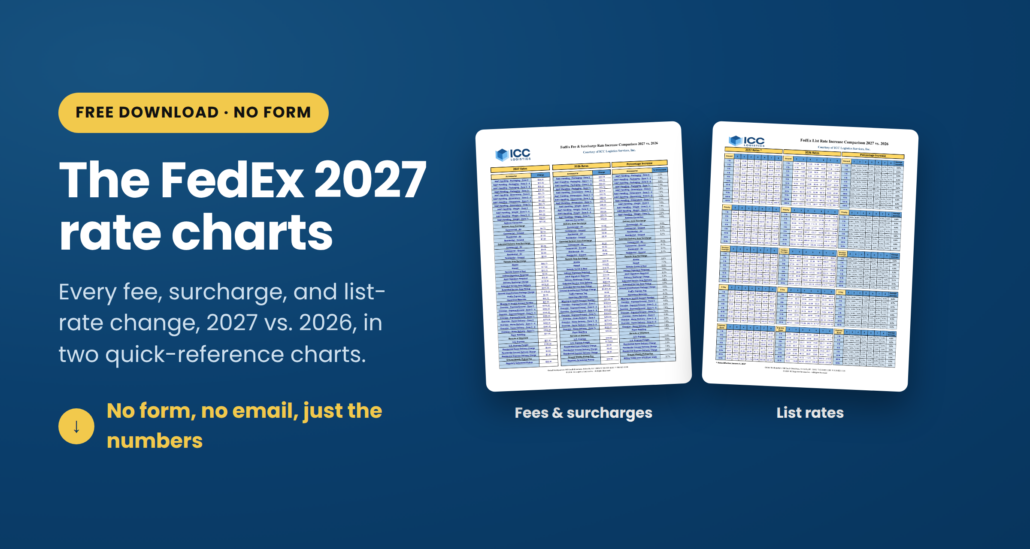
FedEx Fee & Surcharge Rate Increase Comparison 2027 vs. 2026
FedEx List Rate Increase Comparison 2027 vs. 2026
Read More:
2027 Freight Costs: Peak Surcharges, Diesel & FedEx Rates
UPS undercut the fees you shop. It matched the ones you don’t.
