






Today, a significant cost impact on shippers’ freight expenditures is the assessment of Fuel Surcharges imposed by just about every freight carrier across all modes of transportation. For shippers utilizing LTL, Truckload, and Parcel service providers, things appear to be getting way out of control, with Fuel Surcharge costs rising excessively over the years.
A few questions we will clarify for you are, “How did we get here?” and, “When did this all begin?”
Well, the reality is that Fuel Surcharges first appeared on carrier invoices way back in 1973, during the 1973–1974 global fuel crisis—often called the “First Oil Shock.” It was a sudden and severe disruption in the world’s oil supplies that reshaped global economics, politics, and energy policy. At its core, it was triggered by Middle Eastern geopolitics, but its effects rippled across every major economy.
The Organization of Arab Petroleum Exporting Countries (OAPEC) imposed a total oil embargo on the U.S., Netherlands, Japan, Canada, and the U.K. Many gas stations here in the US actually ran dry. Long lines formed for drivers seeking to fuel their vehicles; some stations rationed fuel, e.g., 10 gallons per customer; some states imposed other restrictions, like fueling vehicles on alternate days based on a vehicle’s license plate number. But the bottom line was, we were truly in a major fuel crisis.
That’s the history of how Fuel Surcharges first came into existence, but now we need to understand how domestic freight carriers began implementing them.
Prior to 1980, under Interstate Commerce Commission (ICC) regulation, freight carriers were not free to impose fuel surcharges broadly. They could apply fuel surcharges only when the ICC explicitly authorized them through tariff filings, and those surcharges were limited to line-haul transportation charges—not accessorial services, special fees, or arbitrary add-ons. Here are the facts as they existed back then.
Fuel surcharges required ICC approval
Before deregulation (Motor Carrier Act of 1980), carriers could not unilaterally impose surcharges. Every rate, fee, or surcharge had to be:
- Filed in a tariff,
- Reviewed by the ICC,
- Justified as “just and reasonable,” and
- Applied only to the specific services the ICC approved.
This means fuel surcharges—when permitted—were tied only to line-haul freight rates, because those were the core regulated transportation charges.
Accessorial charges were tightly controlled
The ICC regulated:
- Pickup/delivery fees
- Detention
- Storage
- Special handling
- Household goods services
- Zone-based charges
- Any other non-line-haul service
Carriers could not add fuel surcharges to these fees unless the ICC explicitly approved them (which historically it did not). The ICC’s annual reports and tariff rules showed that accessorial fees were individually defined and fixed—no floating surcharge mechanisms were allowed.
Under current motor carrier regulations, the Motor Carrier Act of 1980 (MCA) does not prohibit carriers from applying fuel surcharges to non‑fuel‑related services. The Act contains no language regulating fuel surcharges at all, nor any provision restricting how carriers structure or apply surcharges.
Fuel surcharges were non-existent before 1973
As stated previously, fuel surcharges began appearing only during the “1973–74 oil crisis,” when carriers petitioned the ICC for emergency relief. Even then:
- The ICC allowed temporary fuel-related adjustments (The key word here is “temporary”)
- The ICC only allowed Fuel Surcharges on line-haul freight charges,
- And, only when published through formal tariff filings.
Two important points here: First, these Fuel Surcharges were clearly meant to be “temporary.” After 53 years, we’re convinced the imposition of these Fuel Surcharges is certainly no longer “temporary.” Today, fuel surcharges are as permanent as carrier General Rate Increases. Get used to them; they are here to stay!
Secondly, some logistics executives have claimed for years that if fuel is a direct cost in carrier pricing calculations before carrier pricing is actually published (which it surely is), are the carriers now “double dipping” by adding a Fuel Surcharge on top of the base rates, which obviously include fuel?
Adding fuel to the fire (no pun intended), is the fact that Fuel Surcharges today, especially in the LTL and parcel shipping environment, are being added to many non-fuel-related accessorial services.
Parcel Carrier Fuel Surcharges came a bit later
The major Parcel carriers implemented their Fuel Surcharges much later than LTL/TL carriers did. FedEx initially applied surcharges primarily to its Express air network based on jet fuel prices, and later expanded these indices to its ground networks in the early 2000’s as global oil prices surged.
UPS announced its first fuel surcharge policy in December, 2000, tying the fee directly to U.S. diesel prices as reported by the U.S. Energy Information Administration (EIA).
Parcel Carrier Fuel Surcharges have evolved significantly since their introduction. Initially, these surcharges only applied to base freight costs. In recent years, UPS and FedEx, as well as other parcel carriers, have continuously expanded their application of Fuel Surcharges to many accessorial fees. For example, UPS now applies the surcharge to 30 different accessorial categories.
To prove this point, see the lists below from both UPS and FedEx that indicate which services they now apply Fuel Surcharges to. Many of these Fuel Surcharges are also being charged by other parcel carriers.
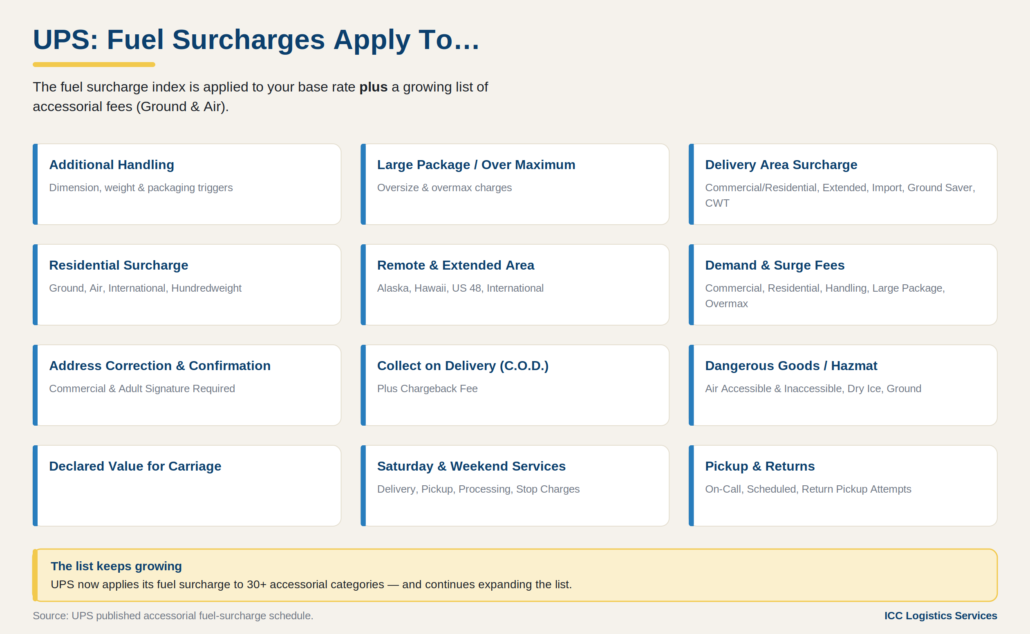
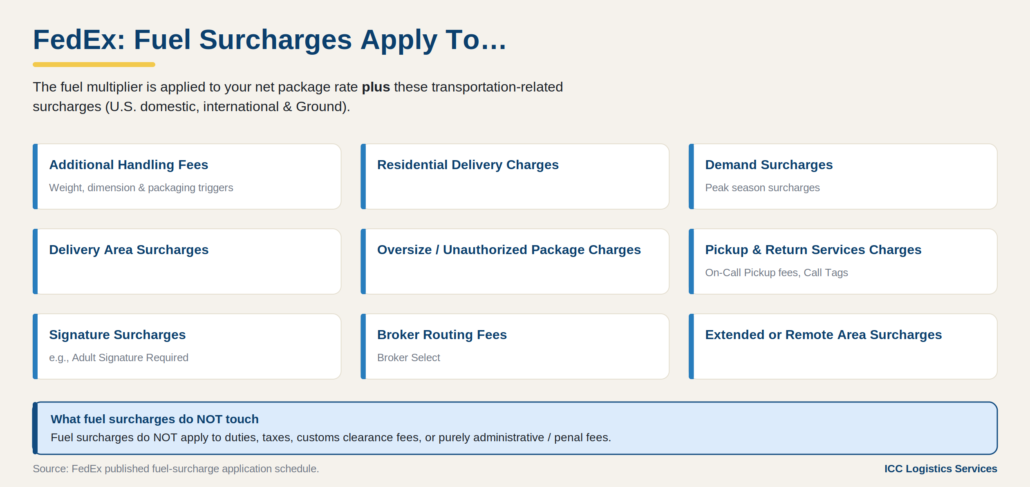
And to put some context into how much these Fuel Surcharges actually raise a shipper’s costs, here are a few actual examples of recent parcel carrier shipments to prove the high cost increases Fuel Surcharges have on parcel shippers today.
For a UPS Ground Commercial 10-pound, zone 6 shipment, the cost of adding fuel to the accessorial charges increases the cost of the below shipment by 13.75% –

For a UPS Ground Residential 27-pound, zone 7 shipment, the cost of adding fuel to the below accessorial charges increases the cost of the below shipment by 15.97%
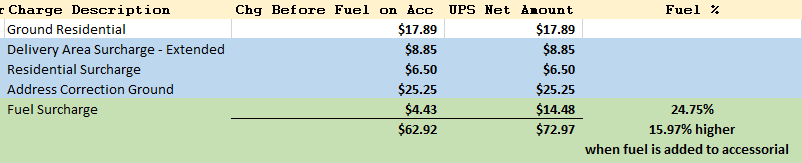
For a UPS Ground Residential 73-pound, zone 6 shipment, the cost of adding fuel to the below accessorial charges increases the cost of the below shipment by 19.95%
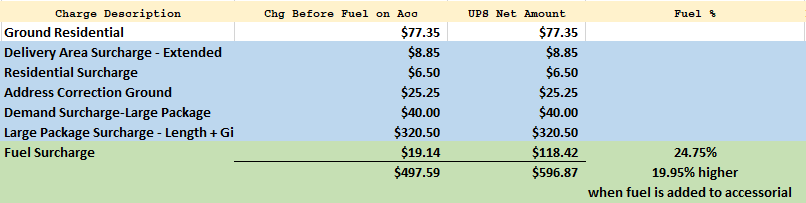
So, what’s a shipper to do? First and foremost, all shippers need to evaluate their current shipping costs and benchmark them against the current marketplace. The good news is that there are Third Party Consultants who have the necessary industry data to properly benchmark all shipping costs, accessorial fees, and contract terms and conditions.
Finally, is there any good news here? We think there is. The Good News is that all shipping costs, service fees, and contract terms and conditions are clearly negotiable. But you have to negotiate from a position of strength. That means, before entering into any carrier negotiations, shippers must obtain the “Power of Industry Knowledge” of all elements of a contract negotiation before entering into any negotiation discussions.
There are resources available through these third-party Independent Logistics Consultants that can ensure a powerful, positive negotiation process each and every time. And, even more importantly, they will provide comprehensive data analytics to prove shipment-by-shipment savings going forward. So, what are you waiting for? Contact our expert consultants by filling out the form below:
Frequently Asked Questions
What is a fuel surcharge in shipping?
A fuel surcharge is a fee carriers add to a shipment to offset fuel costs, calculated as a percentage that floats with diesel or jet fuel prices. It sits on top of the base transportation rate and, increasingly, on top of accessorial fees as well.
When did fuel surcharges start?
Fuel surcharges first appeared on carrier invoices in 1973, during the 1973–74 oil crisis. At the time they were meant to be a temporary, emergency measure applied only to line-haul freight charges, and only when the Interstate Commerce Commission approved them through formal tariff filings.
Why can carriers apply fuel surcharges so freely today?
The Motor Carrier Act of 1980 deregulated trucking and removed the ICC’s tight control over surcharges. The Act contains no language regulating fuel surcharges at all, so carriers are free to structure and apply them however they choose — including on non-fuel-related services.
Do FedEx and UPS apply fuel surcharges to accessorial fees?
Yes. Both carriers now apply their fuel surcharge to a long and growing list of accessorial charges — UPS alone applies it to more than 30 accessorial categories, from additional handling and residential delivery to signature, pickup, and remote-area fees.
Are carriers “double dipping” with fuel surcharges?
It’s a fair question many logistics executives have raised for years. Fuel is already a direct input in the base rates carriers publish, so adding a separate fuel surcharge on top of those rates — and then onto accessorial fees that have little to do with fuel — does appear to charge for the same cost more than once.
How much do fuel surcharges add to shipping costs?
The impact is significant and often hidden. On recent parcel examples, adding fuel to the accessorial charges alone raised the total shipment cost by roughly 14% to 20%, depending on weight, zone, and delivery type.
Are fuel surcharges negotiable?
Yes — all shipping costs, service fees, and contract terms are negotiable, but only from a position of strength. Shippers who enter carrier negotiations armed with current industry data and benchmarking consistently secure better terms than those negotiating blind.
How can shippers reduce fuel surcharge costs?
Start by benchmarking your current rates, accessorial fees, and contract terms against the wider marketplace. Independent logistics consultants have the industry data to identify where you’re overpaying and can prove shipment-by-shipment savings — which is exactly the kind of review ICC Logistics runs for shippers.
